Health › Heart › Blood Pressure
Dr. Gupta Says 'Arterial Cement' Is Why You Can't Lower Your Blood Pressure — And No Pill Was Ever Designed to Dissolve It
The pills, the salt-free diet, the daily walks — everything you've tried to lower blood pressure naturally — Dr. Gupta says none of it was ever designed to address what is actually building up inside your arterial walls..
 Watch: Why Your Blood Pressure Won't Come Down
Dr. Gupta — CNN's chief medical correspondent and member of the National Academy of Medicine. He says what he discovered about high blood pressure is the most important investigation of his career.
If you've done everything your cardiologist told you — taken the pills, cut the salt, walked 30 minutes a day — and that number on your monitor still won't settle, there is something your doctor has almost certainly never said to your face. It was never your fault. And those pills were never designed to fix the actual problem.
The man who says he can prove it is a neurosurgeon who spent decades watching where this ends. And the night it stopped being theoretical, he was standing in his own kitchen.
Discover What Your Cardiologist Never Told You →
Free to watch. No registration required.
If You've Done Everything Right and the Number Still Won't Move — Read This
You are not imagining it. Millions of Americans sit in their cardiologist's office with the same quiet shame: they followed every instruction, took every pill on schedule, cut the salt, walked the neighborhood — and watched that number stay exactly where it was. Or climb. You are not lazy. You are not failing. Something else entirely is happening inside your arteries that no prescription was ever designed to address.
Think about the last few years. Has the number ever come down and stayed down? Or does your cardiologist keep adjusting — a higher dose here, a second medication there — while reassuring you that "we're managing it well"? Managing. Not solving. There is a significant difference between managing a symptom and removing the thing that's causing it.

For the 119 million Americans on blood pressure medication, this is what managing the problem looks like. Not solving it — managing it. There is a difference.
Here's the part nobody says out loud: of the 119 million Americans on blood pressure medication right now, only 1 in 4 ever gets their numbers under consistent control. The other 75% remain at risk — and remain customers. The system was not designed to get you off medication. It was designed to keep you on it, indefinitely, while something invisible continues to harden inside your arteries year after year.
The longer this goes untreated at the root, the narrower that channel gets. Your heart compensates by pushing harder. The harder it pushes, the more damage builds. It is a cycle that accelerates quietly — until one morning it doesn't. The presentation below explains what is actually happening, and why the answer has nothing to do with salt.
See What's Actually Happening Inside Your Arteries →
Free to watch. No registration required.
The Invisible Culprit Your Blood-Pressure Pills Were Never Built to Touch
450%
higher association with cardiovascular events — observed in a March 2024 study
published in the New England Journal of Medicine
In March 2024, Italian researchers published a landmark study in the New England Journal of Medicine. They opened the clogged arteries of 257 patients and sent what they found for analysis. What came back was not just fat or calcium. Inside every single artery they examined, they found microplastics — invisible particles that have been accumulating inside the human body for decades, and that no standard blood pressure test has ever screened for.
Once microplastics enter your bloodstream, they act like microscopic shards of glass — scraping the inner walls of your arteries with every single heartbeat, 24 hours a day. Your body detects the damage and responds the only way it knows how: it layers a sticky, fibrous patch over each wound to stop the bleeding. But because the scraping never stops, the patching never stops either. Layer by layer, that patch traps calcium, fat and more microplastic fragments. It hardens. It calcifies. Dr. Gupta calls it "arterial cement" — a rigid, calcified layer that progressively narrows the channel your blood has to pass through.
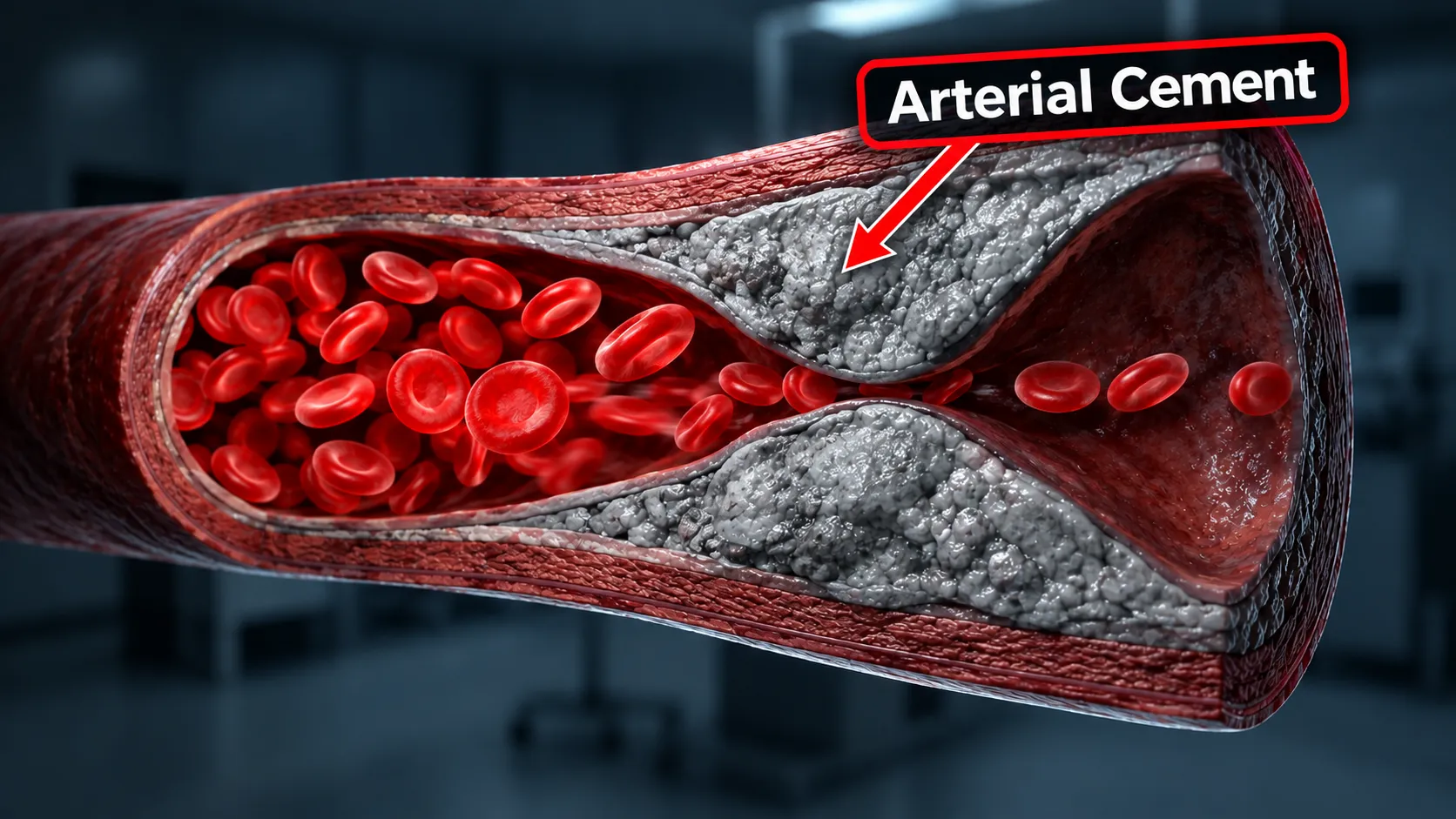
What researchers found inside the arteries of patients with uncontrolled high blood pressure. The hardened crust — what Dr. Gupta calls "arterial cement" — narrows the channel until your heart has to work significantly harder to maintain circulation. Standard blood pressure pills relax the vessel walls. They do not dissolve what is already hardened inside them.
That is why your heart is working so hard. That is why the number on your monitor keeps climbing regardless of how many pills you take. The microplastics keep entering your body — through the water you drink, the air you breathe, the food you eat — and the buildup continues, silently, year after year, while standard medication addresses the numbers on the monitor without reaching what is happening inside the arterial walls.
The Island Where the Numbers Tell a Different Story
If microplastics are the real culprit, then why do the people of Sardinia — a rugged island in the Italian Mediterranean — routinely reach their nineties with arteries that look decades younger than their age? They are not avoiding plastic. They are not taking medication. And they are certainly not eating tasteless food.
Dr. Gupta and his research team spent weeks in the mountainous interior villages of Sardinia studying exactly this question. What they found in the blood tests of local centenarians was striking: an extremely low rate of arterial hardening compared to any population they had studied before. In the United States, nearly 1 in 2 adults lives with high blood pressure. In those Sardinian villages, the rate drops to fewer than 1 in 20. Same planet. Same microplastics in the air. A completely different picture inside their arteries.
The answer, Dr. Gupta discovered, was not a drug. It was not a diet. It was something these mountain communities have consumed for centuries — a specific compound found in that region, never before extracted and made available outside of Italy. Something that appears to do what no prescription has ever been able to do: reach inside the arterial walls and begin reversing the damage from the inside out.

The answer traces back to a few traditional foods of the Sardinian highlands — not the ingredients everyone assumes. The exact compound, how it was identified, and what happened when Dr. Gupta's own wife began using it is shown only in the free presentation below.
>> See the Morning Ritual — Free to Watch
She Did Everything Her Cardiologist Asked. Then Came the Morning She Will Never Forget.
Rebecca — Dr. Gupta's wife, Atlanta, Georgia
For two years, Rebecca took the most commonly prescribed blood pressure medication every single morning without fail. She threw out the salt. She walked an hour in the park every day. She measured her blood pressure three times daily, showed her husband the numbers every night, and watched him — a neurosurgeon with 25 years of experience — go quiet with worry.
The numbers never moved. 160 over 110. 170 over 100. The cardiologist said she was lucky — it would be worse without the pills. Rebecca stopped believing that.
It was their daughter's sixteenth birthday. They made pancakes. They filled balloons. And when Rebecca reached to hand her daughter a plate, she felt something she had never felt before — a sharp, fine pain tearing through her chest. Her left arm gave out. The plate shattered. She was on the floor before anyone could catch her.
In the ambulance, Dr. Gupta held her hand and stared at the heart monitor, counting every second. When the on-call cardiologist came out of the emergency room with the test results, Dr. Gupta said the only thing he could think of: "She did everything right."
The doctor sighed, cleaned his glasses, and said something that changed everything.
That night, sitting alone beside his wife's hospital bed, Dr. Gupta opened his laptop and started searching for an answer. What he found — in an island in the Mediterranean with one of the lowest rates of high blood pressure on the planet, even among people in their nineties — is something no cardiologist ever told Rebecca.
The presentation below shows exactly what he discovered. And why it works when everything else didn't.
The story doesn't end in that hospital room. What Dr. Gupta found next — and what happened to Rebecca's numbers six months later — is in the free presentation below.
Watch the Free Presentation — See How Rebecca's Story Ends →
Free to watch. No registration required.


31,847 Comments
Margaret, Michigan
71 years old, been on three medications since 2019. Nothing ever actually brought the number down for good. I watched the presentation and the arterial cement part finally explained ten years of frustration. My readings improved more in a few months than they had in the previous decade. My doctor was surprised at my last appointment.
Like · Reply · 3h · 71 likes
Frank, Florida
Two weeks in, my readings were the most consistent they had been in years. First time in a long time I didn't get that sinking feeling before I checked the cuff. Figured it was worth two weeks of my time — and it absolutely was.
Like · Reply · 1h · 44 likes
James, retired MD, Ohio
41 years in practice and I was deeply skeptical. But the research behind this has real support in the scientific literature — the New England Journal study alone deserved far more attention than it received. I looked into it myself, and the data is worth understanding.
Like · Reply · 20 min · 88 likes
Diane, Texas
My husband called it the 'morning ritual' and I laughed at him. Six weeks later his readings had improved significantly and he lost a noticeable amount of the water retention he had been carrying from his blood pressure pills. I stopped laughing. The presentation explains it better than I ever could.
Like · Reply · 8 min · 39 likes
This post is no longer accepting new comments.